Physical Address
304 North Cardinal St.
Dorchester Center, MA 02124
Physical Address
304 North Cardinal St.
Dorchester Center, MA 02124

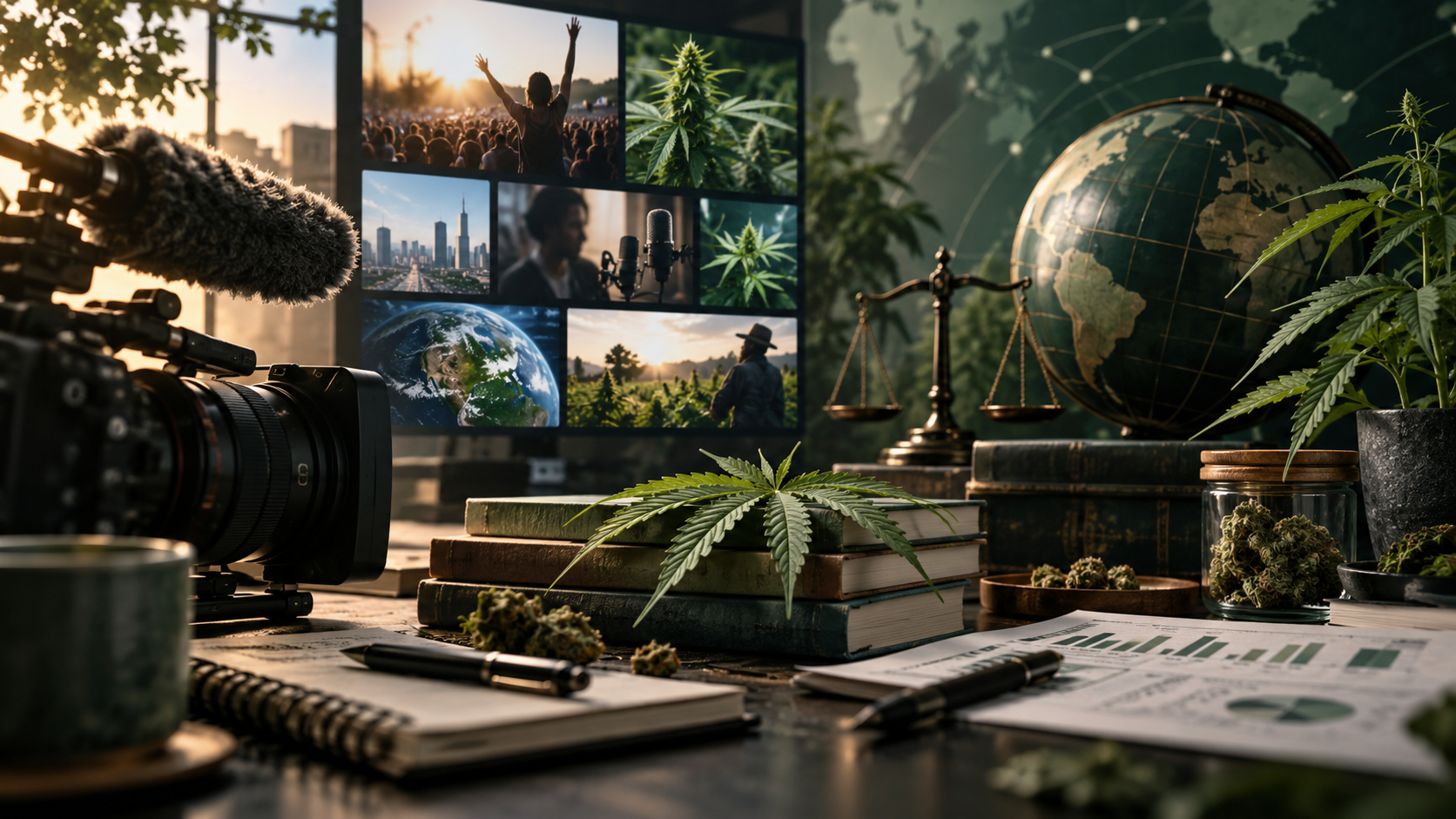
Cannabis culture has changed dramatically over the past several decades.
What was once discussed largely through underground communities, counterculture movements, music, and prohibition-era stereotypes has become part of mainstream conversations about public policy, health, business, entertainment, research, and adult-use regulation.
Today, cannabis appears in newsrooms, documentaries, podcasts, social media, political debates, scientific discussions, and commercial markets around the world.
But cannabis culture is about more than a plant or a product.
It is also about the people, language, media, laws, traditions, debates, and social movements that have developed around cannabis.
At Cannabis Planet, we explore these subjects from an educational and media-focused perspective. Understanding cannabis culture requires looking at how several forces interact, including media representation, public policy, education, industry development, and changing social attitudes.
Cannabis culture is a broad term describing the social practices, language, communities, traditions, media, art, advocacy, and public conversations associated with cannabis.
It can include everything from historical counterculture movements to modern legal-market businesses.
Different communities may experience cannabis culture in very different ways.
For some people, cannabis is primarily associated with:
Because these areas overlap, there is no single definition of cannabis culture.
It continues to evolve alongside changes in law, technology, research, and society.
For much of modern history, cannabis was discussed primarily through the language of prohibition.
Media coverage often centered on arrests, criminal activity, drug enforcement, and political controversy.
As public attitudes began changing, the conversation became more complicated.
Cannabis started appearing in discussions about medical access, criminal justice, economics, agriculture, public health, social equity, and regulated adult-use markets.
This transformation changed the image of the typical cannabis consumer as well.
Modern cannabis audiences can include people from many backgrounds, professions, age groups, and communities.
The result is a culture that is increasingly diverse and difficult to define through old stereotypes.
Media has played an enormous role in shaping public perceptions of cannabis.
Movies, television programs, music, magazines, documentaries, podcasts, and online creators have all contributed to how cannabis is portrayed.
Historically, cannabis-related characters were often represented through exaggerated stereotypes.
The familiar image of the carefree “stoner” became a recurring feature of comedy and popular entertainment.
More recently, media representation has expanded.
Cannabis may now appear in stories about:
This broader representation reflects the increasingly complex position cannabis occupies in society.
Cannabis has long been connected with music and entertainment culture.
Different musical movements have referenced cannabis in lyrics, imagery, fashion, and social identity.
These references helped spread cannabis terminology and symbolism across generations and geographic regions.
As cannabis became more visible in mainstream entertainment, artists and celebrities also began participating in cannabis-related business ventures, advocacy campaigns, and media projects.
This created a new relationship between entertainment culture and the commercial cannabis industry.
However, celebrity involvement should not automatically be interpreted as evidence that a product is safe, effective, or appropriate for every person.
Entertainment and health information should always be distinguished from one another.
One of the most significant changes in modern cannabis culture is the growth of public education.
Many people encounter terms such as:
without fully understanding what those terms mean.
Responsible cannabis education helps explain these concepts without treating cannabis as either completely harmless or inherently dangerous.
Balanced education should address both potential applications discussed in research and known risks such as impairment, unwanted effects, interactions, dependence concerns, respiratory exposure from smoking, and risks to younger people.
Good education gives people context rather than marketing slogans.
Cannabis terminology can be confusing because scientific language, legal terminology, consumer slang, and marketing language often overlap.
Cannabis generally refers to plants within the Cannabis genus and products derived from them.
“Marijuana” is a commonly used term for cannabis, particularly in legal and historical contexts.
Some organizations prefer the broader term “cannabis.”
Hemp is generally a legal classification applied to cannabis that meets specific regulatory definitions, often involving limits on THC content.
Exact definitions differ by jurisdiction.
Cannabinoids are compounds associated with the cannabis plant.
THC and CBD are among the best known, although many others exist.
THC is primarily associated with cannabis intoxication and impairment.
CBD does not produce the same intoxicating effects typically associated with THC, but this does not mean every CBD product is automatically appropriate or risk-free.
Terpenes are aromatic compounds found in cannabis and many other plants.
They contribute to scent and flavor characteristics.
Understanding terminology helps readers evaluate information more critically.
Public attitudes toward cannabis have changed significantly.
In many places, discussions have shifted from whether cannabis should exist within society to questions about how it should be regulated.
These discussions may involve:
Different communities reach different conclusions about these issues.
That is one reason cannabis policy continues to generate debate even in jurisdictions where some forms of use are legal.
Cannabis policy is complicated because laws can differ significantly between jurisdictions.
A product or activity permitted in one location may remain prohibited somewhere else.
Regulations may cover:
Legalization does not mean the absence of regulation.
In many jurisdictions, legal cannabis markets are governed by extensive rules designed to address public health, consumer protection, taxation, and access.
Readers should always check current official information relevant to their own location.
Cannabis Planet does not provide legal advice.
Cannabis policy intersects with several major public issues.
These include healthcare, policing, criminal justice, economics, agriculture, taxation, employment, and personal liberty.
As governments modify their policies, journalists and media organizations are increasingly required to understand terminology that was once largely confined to specialist communities.
Accurate reporting matters because confusing legal changes with health claims can mislead audiences.
A jurisdiction changing its cannabis laws does not automatically prove that cannabis is medically beneficial, harmless, or appropriate for everyone.
Legal policy and medical evidence are separate questions.
Legal and regulated cannabis markets have created a rapidly developing business sector.
The broader industry can involve:
This expansion has helped move cannabis discussions into mainstream business media.
At the same time, commercial growth creates new challenges.
Companies have strong incentives to attract customers and differentiate products.
Consumers should therefore distinguish educational information from advertising.
Terms such as “premium,” “natural,” “clean,” “wellness,” or “craft” may sound appealing but should not automatically be treated as scientific evidence.
Cannabis-focused media has developed alongside the industry itself.
Dedicated websites, podcasts, video channels, newsletters, documentaries, and social accounts now cover cannabis from many different perspectives.
Some focus on:
This diversity can be valuable, but it also requires readers to evaluate sources carefully.
A professional-looking website does not automatically guarantee accurate information.
Readers should ask:
Who produced this information?
What evidence supports the claim?
Is the content editorial or promotional?
Are important risks being discussed?
Is the information current?
These questions are increasingly important in the modern digital media environment.
Social media has accelerated the spread of cannabis culture.
Images, terminology, product trends, memes, advocacy campaigns, and news can move around the world within hours.
Platforms have also allowed cannabis communities to connect across geographic boundaries.
However, social media has limitations.
Short-form posts often remove important context.
A dramatic personal story or viral video may not accurately represent scientific evidence or the experience of the wider population.
Algorithms may also reward content that is emotional, controversial, or visually striking rather than information that is balanced and carefully explained.
Cannabis education therefore requires more than simply following trends.
Modern cannabis audiences regularly encounter content that looks educational but is actually marketing.
This can include:
Commercial content is not automatically unreliable.
However, readers should understand when financial interests may influence how information is presented.
Transparent disclosure is an important part of responsible cannabis media.
Cannabis is also an active area of scientific investigation.
Researchers continue studying cannabinoids, potential medical applications, impairment, mental health effects, dependency, respiratory exposure, pregnancy, cognition, and other areas.
Scientific research develops over time.
A single study rarely answers every question.
Headlines suggesting that one study has “proven” cannabis to be completely beneficial or completely harmful should be approached carefully.
Reliable scientific understanding usually develops through multiple studies, different research methods, replication, and ongoing review.
Adult-use legalization has increased the importance of responsible-use education.
Cannabis can impair:
Anyone who is impaired should not drive or operate machinery.
The degree of impairment can vary between people and products.
Responsible awareness also means remembering that legal access does not make cannabis appropriate for every individual.
Impaired driving remains an important public-safety concern.
Cannabis may affect skills necessary for safe driving, including attention, coordination, decision-making, and reaction time.
People should not attempt to judge their own ability to drive based only on whether they “feel fine.”
If someone is impaired, driving should be avoided.
Cannabis products should be stored securely and kept away from children and teenagers.
Young people may face different risks than adults because the brain continues developing through adolescence and early adulthood.
Legal adult-use markets generally include minimum-age requirements for this reason.
Cannabis marketing should also avoid intentionally appealing to minors.
Responsible cannabis culture includes secure storage.
Products should be:
Good storage practices reduce accidental exposure.
Cannabis can affect mood, thought, perception, and cognition.
Some individuals may experience anxiety, paranoia, confusion, or other uncomfortable psychological effects.
Risk can vary depending on the individual, product composition, frequency of exposure, and other factors.
People with concerns about their mental health should discuss cannabis-related questions with an appropriate healthcare professional.
Pregnancy and breastfeeding require special consideration.
People who are pregnant, planning pregnancy, or breastfeeding should seek professional medical guidance regarding cannabis exposure.
The fact that cannabis is plant-derived should not be interpreted as proof that it is safe during pregnancy.
Combining cannabis with alcohol or other intoxicating substances can increase impairment and make effects more difficult to predict.
Certain medications may also interact with cannabis products.
People taking prescription medicines should ask an appropriate healthcare professional or pharmacist about potential interactions when relevant.
Cannabis information sits between several competing forces.
There are people who strongly support legalization.
There are people who strongly oppose it.
There are companies trying to sell products.
There are advocacy organizations attempting to change policy.
There are researchers trying to understand health effects.
And there are consumers simply trying to make sense of it all.
This makes balanced information especially valuable.
A responsible cannabis media platform should be willing to discuss both benefits claimed or investigated and legitimate risks or uncertainties.
Readers should be cautious when encountering claims such as:
Oversimplified claims rarely reflect the complexity of cannabis research or regulation.
Reliable education should acknowledge uncertainty when uncertainty exists.
Cannabis media will likely continue evolving alongside technology, regulation, research, and culture.
Future coverage may increasingly focus on:
Video, podcasts, interactive media, and social platforms will also continue changing the way cannabis information reaches audiences.
The challenge will be maintaining accuracy while competing in an increasingly fast-moving media environment.
Cannabis culture is no longer limited to a single country or social movement.
Different regions are developing their own conversations around cannabis.
Some focus primarily on medical access.
Others focus on decriminalization, regulated adult use, agriculture, traditional practices, or criminal justice reform.
This global diversity is one reason the name Cannabis Planet reflects our editorial direction.
The modern cannabis conversation stretches across borders, industries, communities, and cultures.
Cannabis culture can include creativity, community, advocacy, entertainment, and social history.
But responsible coverage should also acknowledge:
Celebrating or examining culture does not require ignoring these issues.
In fact, mature cannabis culture should be able to discuss them openly.
When evaluating cannabis information online, consider the following questions:
Is the source clearly identified?
Readers should know who is publishing the information.
Are claims supported?
Major health, legal, or scientific claims deserve appropriate evidence.
Is advertising clearly separated from editorial content?
Financial relationships should not be hidden.
Does the article acknowledge limitations?
Complex topics rarely have perfectly simple answers.
Is the information current?
Cannabis policy and research can change quickly.
Does the content encourage responsible behavior?
Responsible media should not ignore impairment, legal restrictions, or public-health considerations.
Cannabis Planet aims to cover cannabis as a serious cultural, educational, media, and public-interest topic.
Our coverage may explore:
We believe good cannabis coverage should inform rather than simply promote.
We also believe readers deserve enough context to distinguish cultural trends, marketing claims, scientific evidence, and legal developments from one another.
Cannabis culture has moved from the margins of public conversation into mainstream media, politics, business, science, and entertainment.
That transformation has created new opportunities for education—but also new opportunities for misinformation.
Media influences how cannabis is perceived.
Policy determines how it is regulated.
Industry influences how it is marketed.
Education helps people understand what all of those developments actually mean.
As the cannabis world continues to evolve, responsible media will become increasingly important.
Understanding cannabis culture requires more than following trends or repeating headlines. It requires examining history, policy, science, business, media, and public health together.
That is the conversation Cannabis Planet aims to explore.
— Pedro Gutierrez